

Engineering Scalable Charging Infrastructure for Autonomous Fleets: The Case for Overhead Wireless Power Delivery
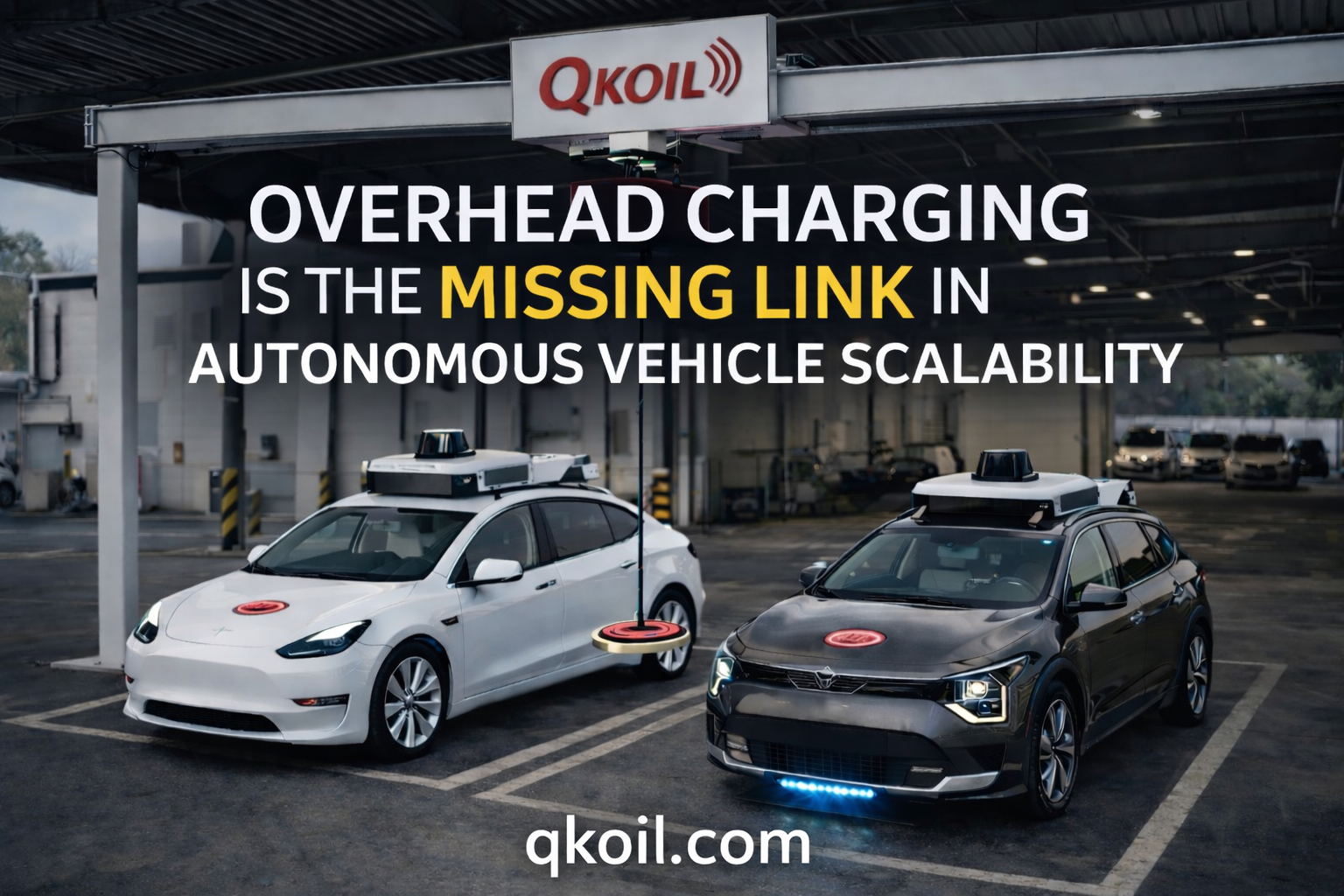
Overhead charging for fleet scalability
Autonomous vehicle technology has advanced rapidly in perception systems, sensor fusion, AI decision-making, and fleet orchestration. However, one of the least discussed, yet most operationally critical, challenges remains energy replenishment. As autonomous vehicle fleets transition from pilot programs to large-scale commercial deployment, charging infrastructure must evolve from a human-assisted process into a fully automated subsystem of the mobility stack.
Conventional charging architectures introduce structural inefficiencies when applied to autonomous fleets. Plug-in systems require manual handling or robotic interfaces, both of which increase system complexity, maintenance requirements, and operational cost. Ground-based inductive charging pads reduce some manual interaction but introduce other constraints, including real estate consumption, debris exposure, drainage considerations, thermal management challenges, and vehicle alignment tolerances that must be maintained at ground level.
For high-utilization fleets operating in dense depots or urban mobility hubs, these constraints directly affect throughput, uptime, and total cost of ownership.
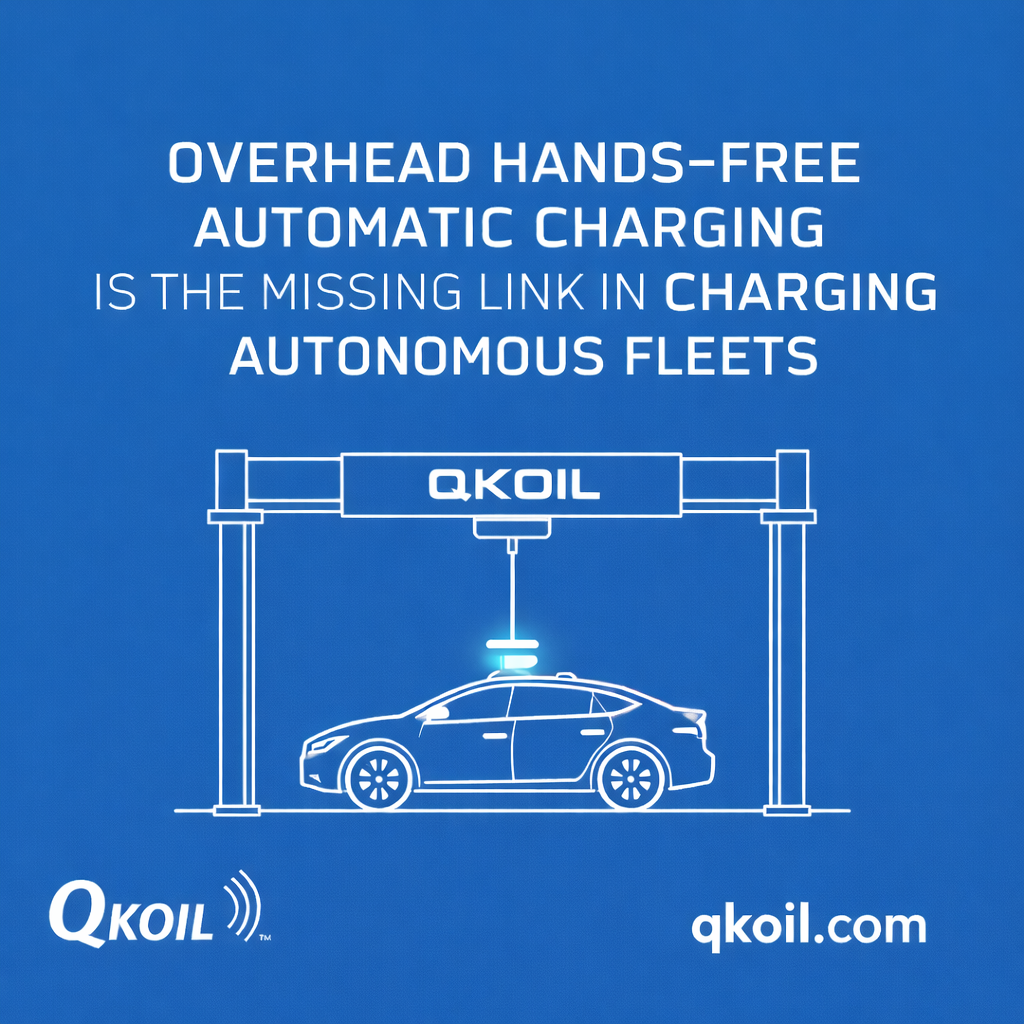
QKOIL™ approaches the problem from an infrastructure-first engineering perspective by relocating the primary transmitting hardware overhead. The system utilizes a gantry-supported transmitting coil suspended above the vehicle envelope. A low-profile receiving coil is integrated into the hood of the autonomous vehicle platform. During charging, the vehicle positions beneath the gantry, aligning the hood-mounted receiving coil with the overhead transmitter to establish inductive power transfer.
This overhead configuration introduces several engineering advantages.
First, ground plane real estate remains unobstructed. Fleet operators retain flexibility in traffic flow design, drainage engineering, and site layout optimization without embedding power transfer hardware into pavement structures.
Second, environmental exposure of critical power transfer components is reduced. Overhead mounting mitigates accumulation of water, debris, oil, and road contaminants that commonly affect ground-based systems.
Third, alignment control becomes a vehicle-to-structure problem rather than a vehicle-to-ground interface problem. Autonomous navigation systems can be programmed to achieve repeatable positioning beneath a fixed overhead transmitter using sensor-based localization, visual markers, or integrated depot guidance systems.
Fourth, infrastructure scalability improves. Gantry-based systems can be modularly deployed across charging lanes, integrated into depot ceilings, or adapted to structured parking environments. The architecture supports phased expansion as fleet size increases, without excavation or pavement retrofitting.
From a systems engineering standpoint, overhead wireless charging enables tighter integration between fleet management software and physical energy delivery infrastructure. Charging cycles can be scheduled, sequenced, and optimized algorithmically, supporting continuous vehicle utilization with minimal human oversight.
As autonomous fleets move toward 24/7 operational models, downtime reduction becomes an engineering imperative. Charging infrastructure must function as a seamless subsystem within the broader autonomous ecosystem, not as a legacy interface requiring manual intervention or spatial compromise.
Overhead hands-free automatic charging represents a structural rethinking of wireless power delivery for mobility platforms. By elevating the transmitting architecture and integrating a hood-mounted receiving interface, QKOIL™ is engineering charging systems designed specifically for the operational realities of autonomous fleet deployment.
Autonomy at scale requires infrastructure designed for autonomy.
For technical inquiries or partnership discussions, contact info@qkoil.com.
Overhead charging