

QKOIL™ Files New Patent Application for Decentralized Overhead Charging Architecture for Autonomous and Fleet Vehicles
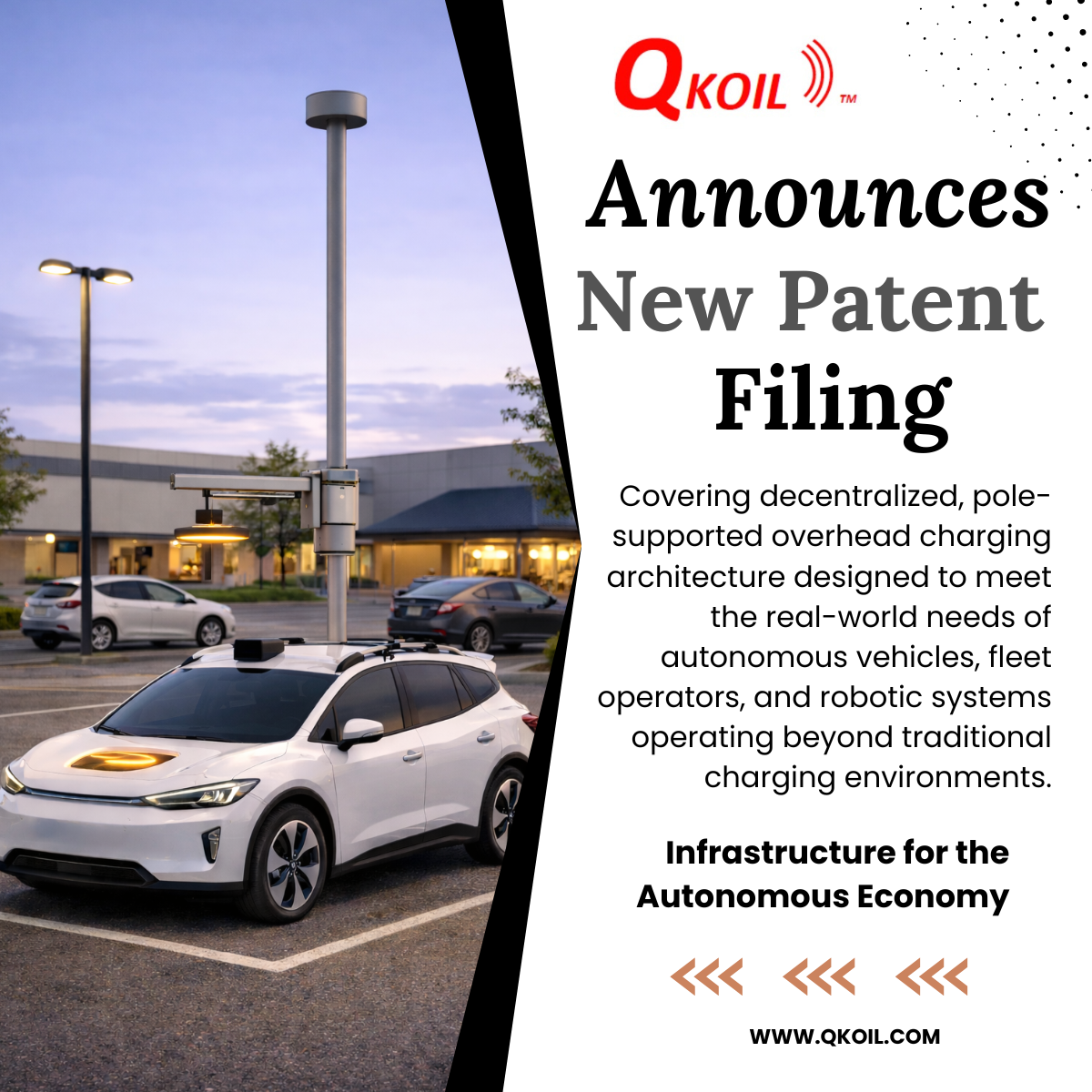
QKOIL Charging Architecture
EV Charging Solutions, LLC (“QKOILTM”) has filed a new patent application covering a decentralized, pole-supported overhead charging architecture designed to meet the real-world needs of autonomous vehicles, fleet operators, and robotic systems operating beyond traditional charging environments.
The patent application entitled “Decentralized Overhead Charging Architecture for Autonomous and Fleet Vehicles,” is part of a growing intellectual property portfolio including patent applications filed in the U.S and other markets such as Europe, China, Korea, India, etc.
This newly filed application builds on QKOIL’s vision of infrastructure-light, intelligent charging, bringing power to the vehicle only when and where it’s needed, without requiring fixed ground pads or human intervention.
A Smarter Way to Charge Autonomous Vehicles
At the core of this new invention is a pole-supported overhead charging assembly that can automatically detect an approaching vehicle registered with the system, dynamically align a power transmitter to a power receiver installed on/in the vehicle’s surface, and initiate charging, all without requiring precise vehicle navigation to align charging elements underneath an autonomous vehicle. The system can either be wireless based using aligned transmitting and receiving coils to achieve inductive wireless charging of an autonomous vehicle (AV) or wired using robotics to automatically plug into the AV for fast charging.
Unlike fixed or embedded charging systems, the QKOIL™ architecture allows the charging hardware to move in multiple dimensions to achieve alignment with the vehicle’s receiver. Once charging is complete, or if the vehicle signals a need to depart, the system retracts and returns to a stowed position near the top of the pole, where it can avoid vandalism, pose minimal obstruction on the ground, and encounter less wear.
Because each charging unit can operate independently, the QKOIL™ charging system concept supports a distributed deployment model, enabling scalable charging networks across cities, depots, campuses, and industrial sites. Now, rather than having to travel to a charging depot where a human must plug into an autonomous vehicle, autonomous vehicles can find charging infrastructure in parking lots throughout a metropolitan area. Autonomous taxis, for example, can now remain in a revenue generation mode for longer periods throughout the day.
Key Advantages for Autonomous and Fleet Operators
For autonomous vehicle companies and fleet managers, the benefits are immediate and practical:
No ground pads, no manual intervention
Ideal for fully autonomous operation where ground space and human involvement is limited or unavailable.
Flexible vehicle alignment for Wireless Systems
The system automatically can position an overhead transmitter down from its stowed position on the upper area of a vertical pole to achieve optimal coupling with a receiver on the AV, reducing downtime caused by misalignment.
Flexible vehicle alignment for Wired/Robotic Systems
The robotically controlled plug-in fast charge system can be automatically positioned from its stowed position on the upper area of a vertical pole down to and near the side of an AV for the robotics to open and plug-into the AV’s receptacle for AV charging.
Decentralized scalability
Individual pole-based charging systems can be deployed incrementally across large geographic areas without major infrastructure disruption.
Reduced wear, contamination, and Vandalism
By keeping charging hardware off the ground, each system avoids debris, water, ice, and surface damage common in outdoor environments. Vandalism is also reduced given the system’s stowage high above the ground where it is out of reach from pedestrians.
Moving Beyond Fixed and Ground-Based Charging
Most existing wireless and automated charging solutions rely on ground-embedded pads with tightly constrained vehicle positioning, all of which introduce deployment complexity, maintenance challenges, and operational friction, especially in outdoor, high-traffic, or unmanned environments. The QKOILTM pole-supported, decentralized overhead architecture takes a fundamentally different approach by allowing the charging system itself to actively move and align to the vehicle, rather than forcing the vehicle to precisely align with a static infrastructure.
This shift reduces installation costs, improves tolerance to real-world variability, and enables scalable, city-wide or facility-wide deployments without trenching, floor modifications, or centralized charging bottlenecks. The result is a more resilient, flexible charging solution purpose-built for autonomous fleets and robotic systems operating at scale.
Beyond Roads: Warehouses, Fields, and Forward Operations
While autonomous road vehicles are an obvious use case, the potential applicability of this architecture is intentionally broad, and that’s where its real power shows.
Warehouse & Logistics Automation
Autonomous Mobile Robots (AMRs) and Automated Guided Vehicles (AGVs) can recharge opportunistically beneath overhead poles without stopping production lines or returning to centralized charging docks. This supports higher utilization, continuous operation, and smarter fleet orchestration inside and outside fulfillment centers and factories.
Agricultural Autonomy
Autonomous tractors, sprayers, and field robots can be charged directly in the field, reducing the need to return equipment to a barn or depot and enabling longer autonomous work cycles during planting and harvest seasons.
Military & Field Operations
In defense and remote field applications, the system supports rapid, modular deployment of charging infrastructure for autonomous ground vehicles, without exposing personnel or requiring hardwired installations in austere environments
Designed for the Autonomous Future
This new patent application filing reflects QKOIL’s belief that charging infrastructure must evolve alongside autonomy itself. As vehicles become more intelligent and independent, the systems that power them must be just as adaptive and autonomous.
By combining overhead wired and wireless power transfer, intelligent sensing, and decentralized deployment, QKOILTM continues to push toward a future where autonomous systems can operate longer, safer, and with fewer constraints, wherever the mission takes them.
To learn more about QKOIL™’s technology roadmap or partnership opportunities, stay connected with EV Charging Solutions, LLC.
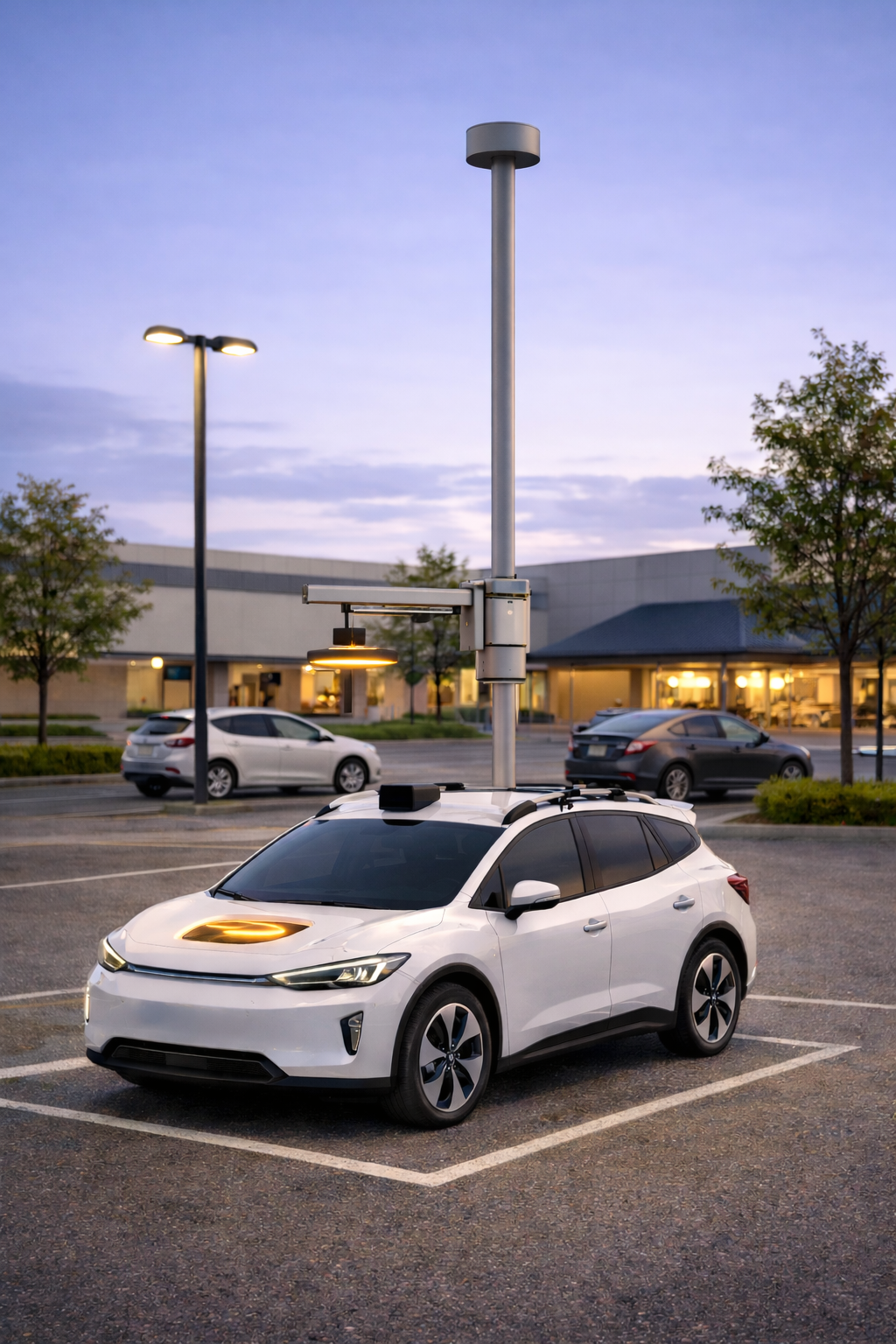
Charging infrastructure for autonomous vehicles