

How Robotics and Machine Learning Enable the QKOIL™ Autonomous Charging Platform
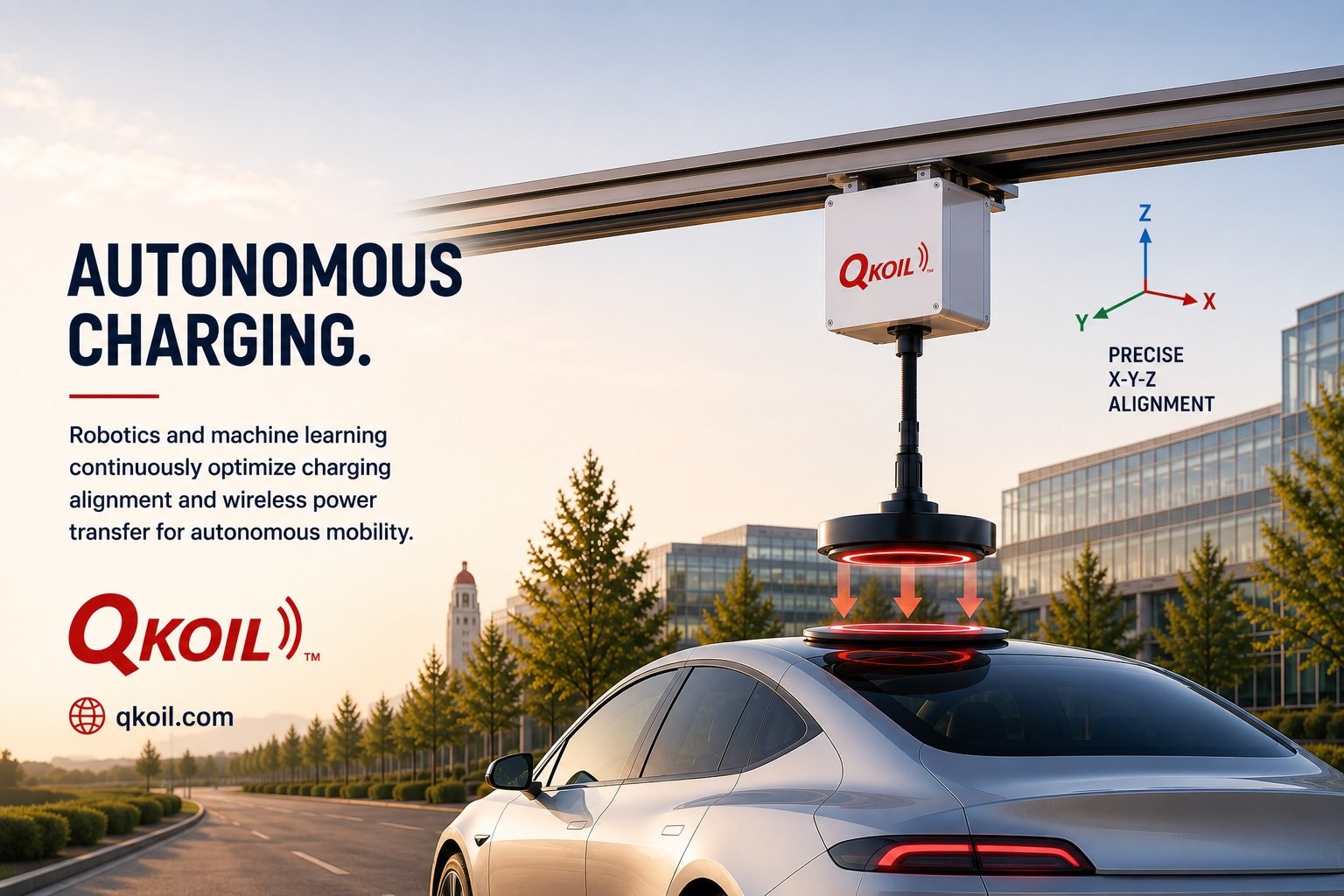
As electric vehicles (EVs), autonomous vehicles (AVs), autonomous mobile robots (AMRs), and other autonomous systems become increasingly common, one critical challenge remains: charging. While vehicles and robots are becoming more autonomous, charging still requires human intervention or fixed infrastructure that limits flexibility and scalability.
At QKOIL™, we believe autonomous mobility deserves autonomous charging.
How Are Robotics Used in the QKOIL™ Autonomous Charging Platform?
Robotics and machine learning play important roles in implementing the QKOIL™ autonomous charging platform. The overhead QKOIL™ charging system operates using an elevated gantry structure that deploys an inductive transmitting coil in an x-y-z direction toward a receiving coil located on a vehicle or robotic platform.
The receiving coil may be positioned on a vehicle roof, hood, front compartment, cargo compartment, equipment enclosure, or other suitable location and can be electronically connected to a battery management system (BMS) or other electrical power subsystem.
The transmitting coil may be deployed using a robotic arm, telescoping mechanism, articulated linkage, suspended charging module, or a vertically lowered charging assembly. In some implementations, the QKOIL™ charging mechanism may move along an overhead rail system to service multiple vehicles or robots, while in other embodiments the charging system may remain stationary above a designated charging position.
Robotics plays an important role because the charging platform must repeatedly and accurately position charging components relative to the vehicle. Unlike traditional plug-in charging systems, autonomous charging requires the charging hardware itself to intelligently move, align, and adapt to varying vehicle positions and charging requirements.
Why Precise Positioning Matters
Wireless charging performance is highly dependent on alignment between transmitting and receiving coils.
The relative position and separation distance (or charging gap) between the coils can significantly influence charging efficiency, power transfer, thermal performance, and overall system effectiveness.
Different vehicle manufacturers, vehicle architectures, battery systems, and robotic platforms may exhibit different charging characteristics. For example, a particular charging gap that produces optimal efficiency for one vehicle platform may not necessarily be ideal for another. Similarly, AMRs operating in warehouses, industrial facilities, hospitals, airports, or logistics centers may have different charging requirements than passenger vehicles or autonomous shuttles.
As a result, a successful autonomous charging platform benefits from the ability to dynamically position charging components and adapt charging parameters based on observed operating conditions.
This is where robotics and machine learning become particularly valuable. Together, these technologies may enable the charging platform to adapt to different vehicle platforms and operating environments while maintaining reliable charging performance.
The importance of autonomous charging may continue to increase as robotaxis, autonomous delivery vehicles, warehouse AMRs, unmanned ground vehicles, and other autonomous systems become more widely deployed. While these platforms may operate with limited or no human intervention, many still require some form of manual charging interaction. Autonomous charging infrastructure has the potential to reduce this dependency while improving operational uptime and fleet utilization.
Robotics as an Intelligent Positioning System
At its core, the robotic function of the QKOIL™ platform is relatively straightforward compared to many industrial robotic systems.
Unlike automotive manufacturing robots that perform welding, painting, assembly, or material handling operations involving six-axis motion, force control, tooling changes, and high-speed precision movement, the QKOIL™ charging platform typically performs a more limited set of actions.
Because the robotic motion requirements are generally less complex than those found in many manufacturing environments, implementation costs may be significantly lower while maintaining high levels of reliability and automation. By focusing on a charging-specific application rather than general-purpose industrial automation, autonomous charging systems may benefit from reduced mechanical complexity, fewer moving components, and lower deployment costs. This may facilitate broader adoption across commercial and fleet charging environments.
This simplified robotic architecture may enable autonomous charging deployment in parking facilities, fleet depots, robotaxi hubs, airports, warehouses, manufacturing plants, municipal facilities, and commercial properties without requiring highly specialized industrial automation systems.
Machine Learning: Teaching the System to Charge More Efficiently
Machine learning allows the charging platform to continuously improve performance over time.
Rather than relying solely on predetermined positioning coordinates, machine learning algorithms can learn from previous charging sessions and identify patterns that improve charging efficiency, alignment accuracy, throughput, and overall system operation.
Several categories of machine learning techniques may be applicable.
Computer Vision and Object Recognition
Computer vision systems can identify approaching vehicles, robots, or equipment and determine their position within the charging area. Convolutional neural networks (CNNs) and other vision-based learning systems may assist in accurately locating charging targets and guiding robotic positioning.
Computer vision may also enable the charging platform to accommodate variations in vehicle positioning, environmental conditions, and charging target locations. By interpreting visual information in real time, the system may assist robotic positioning systems in achieving reliable charging alignment under a wide range of operating conditions.
Reinforcement Learning
Reinforcement learning may be particularly useful for optimizing charging operations.
In reinforcement learning, a system learns through repeated trial-and-feedback cycles. The platform receives positive rewards for achieving desirable outcomes such as higher charging efficiency and increased throughput. Over time, the system can learn the most effective positioning strategies for specific vehicle types, environments, and operating conditions.
Predictive Analytics
Machine learning can also be used to anticipate charging requirements before a vehicle arrives. By analyzing historical charging patterns, fleet schedules, traffic flow, operational data, and battery state-of-charge information, predictive algorithms may help determine, for example, resource allocation priorities. This type of predictive optimization becomes increasingly valuable for robotaxi fleets, warehouse robotics systems, and autonomous logistics operations.
Adaptive Gap Optimization
One particularly interesting application of machine learning is dynamic charging-gap optimization. The charging platform can continuously monitor parameters such as power transfer efficiency, thermal conditions, alignment characteristics, and related operating parameters. Machine learning algorithms may then determine the optimal spacing between charging coils for specific operating conditions. As additional charging sessions occur, the system develops a growing knowledge base that can improve future charging performance across an entire fleet.
Creating a Continuously Improving Charging Ecosystem
Perhaps the greatest advantage of combining robotics with machine learning is that the charging system becomes increasingly intelligent over time.
Every charging event generates valuable data.
Every alignment sequence provides feedback.
Every vehicle interaction creates opportunities for optimization.
The result is a charging platform that can continuously refine its positioning strategies, charging parameters, fleet management decisions, and overall operational efficiency.
Rather than functioning as a static charging station, the QKOIL™ platform can evolve into an adaptive charging ecosystem capable of supporting increasingly sophisticated autonomous transportation and robotics applications.
Looking Ahead
The future of transportation is becoming autonomous. The future of logistics is becoming autonomous. The future of robotics is becoming autonomous.
Charging infrastructure must evolve as well.
By combining simplified robotic positioning systems with advanced machine learning techniques, the QKOIL™ autonomous charging platform seeks to provide a practical path toward hands-free charging for electric vehicles, autonomous fleets, autonomous mobile robots, and next-generation mobility systems.
As robotics, artificial intelligence, and autonomous transportation technologies continue to mature, autonomous charging may become a foundational element of future mobility infrastructure. The convergence of robotics, machine learning, and wireless power transfer has the potential to transform charging from a manual task into an intelligent, automated service that operates seamlessly in the background of everyday transportation and logistics operations.
Importantly, the same autonomous charging concepts may be applicable across a broad range of platforms, including passenger EVs, autonomous vehicle fleets, warehouse AMRs, industrial robotics, airport ground support equipment, and other electrically powered autonomous systems. The convergence of robotics, machine learning, and wireless power transfer has the potential to transform charging from a manual task into an intelligent, automated service that operates seamlessly in the background of everyday transportation and logistics operations.