

QKOIL™ Expands Its Patent Portfolio With Two New Filings Covering the Future of Autonomous Charging Infrastructure
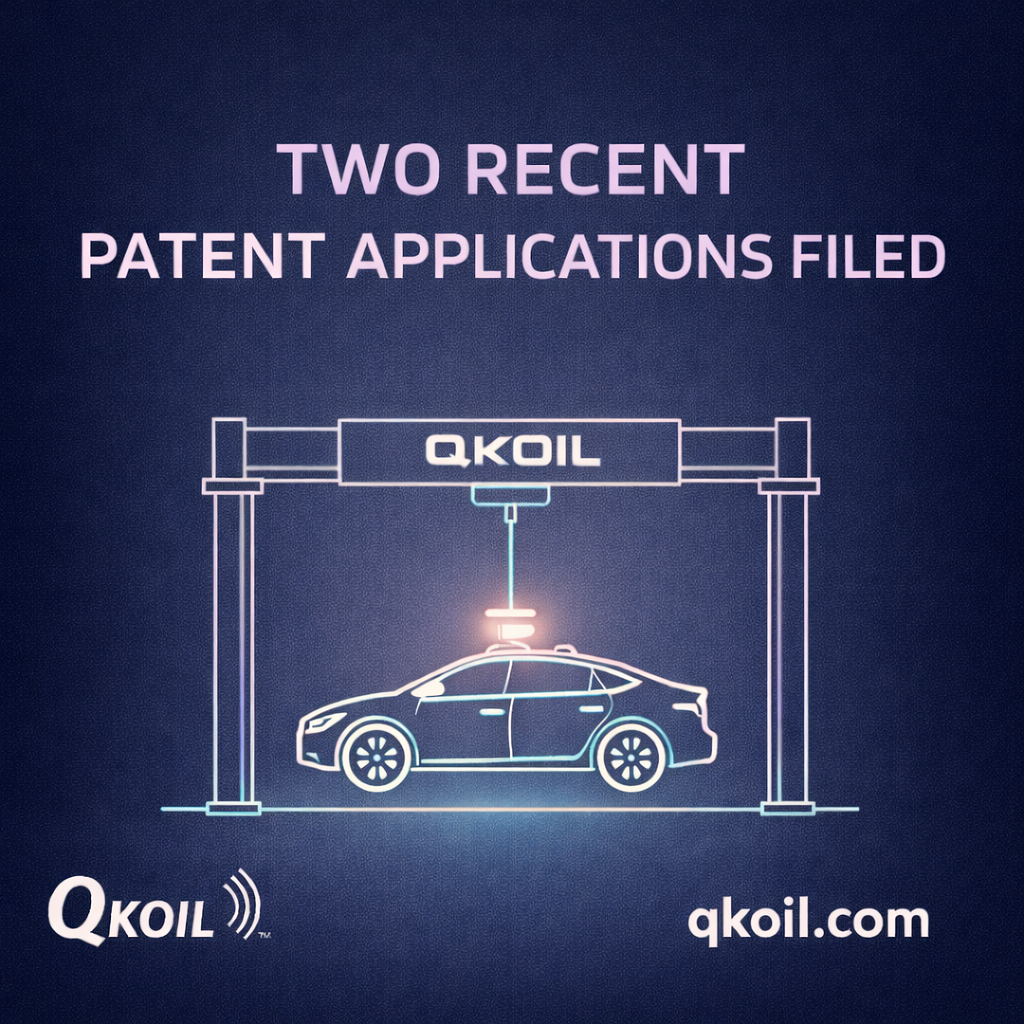
EV Charging Systems LLC (dba QKOIL™) has filed two new patent applications that mark a significant milestone in the company's growing intellectual property portfolio. These filings join a portfolio of patent applications filed and issued in the United States, together with international patent applications filed under the Patent Cooperation Treaty (PCT), collectively staking out QKOIL™'s foundational position in the emerging field of autonomous charging infrastructure.
The two new applications cover innovations that go well beyond the company's core overhead wireless charging platform. Together, they address the full-stack challenge of truly autonomous charging: not just delivering power contactlessly, but doing so intelligently, adaptively, and without any human involvement, and at the scale that next-generation autonomous vehicle and robot fleets will demand.
A Growing Patent Portfolio in a Critical Emerging Field
Before describing the two new filings, it's worth putting them in context. The charging infrastructure space is at an inflection point. The question is no longer whether autonomous vehicles, robotaxis, and AMR fleets will dominate transportation and logistics; it's a matter of when. What remains largely unsolved is how those fleets will be charged at scale, reliably, and without reintroducing the human labor that autonomy was designed to eliminate.
QKOIL™'s patent strategy targets exactly this gap: building a portfolio of foundational innovations that define the architecture, methods, and intelligence layer of a truly autonomous charging ecosystem. These two new applications extend that strategy into new terrain.
Patent Application #1: Decentralized Overhead Charging Architecture for Autonomous Vehicle Fleets
The first new patent application titled "DECENTRALIZED OVERHEAD CHARGING ARCHITECTURE FOR AUTONOMOUS VEHICLE FLEETS," addresses one of the most underappreciated structural problems in autonomous fleet operations: the dependency on centralized charging depots.
Today, most autonomous vehicles, including commercial robotaxis operating in major metropolitan areas, must return to a central operator depot to be recharged. At that depot, a human typically plugs the vehicle in. This model has two fundamental problems. First, it is not autonomous. The charging process reintroduces the human labor that the vehicle itself has eliminated. Second, it creates a geographic chokepoint: every vehicle in the fleet must return to the same location, incurring dead-mileage, queuing delays, and significant downtime that directly reduces operator revenue and fleet utilization.
The innovations covered by this patent application solve these problems by enabling a distributed network of overhead charging stations deployed throughout the geographic area in which a fleet operates, whether a metropolitan district for robotaxis, a fulfillment center campus for AMR fleets, or a logistics hub for automated guided vehicles. Rather than routing every vehicle to a single central hub, the decentralized architecture allows vehicles and robots to access charging at or near their point of operation, dramatically reducing downtime and eliminating the need for human involvement in the charging process entirely.
Key innovations covered by this application include:
— A vertical pole-supported overhead charging system in which a wireless power transmitter is stowed near the top of the pole when not in service, and deployed automatically along the pole's vertical axis in the X, Y, and Z directions to achieve precise alignment with the receiver coil on an arriving vehicle or robot — without any human assistance.
— A control system capable of detecting the presence or approach of an autonomous vehicle or AMR within the charging area, autonomously positioning the transmitter for optimal coupling, initiating power transfer, monitoring charging parameters in real time, and recovering the transmitter to its stowed position upon charging completion or vehicle departure.
— A network architecture in which multiple overhead charging stations are distributed across a geographic area — such as street-level locations throughout a city for robotaxi fleets, or across multiple zones within a large warehouse campus — allowing vehicles and robots to access charging without a long detour back to a central hub.
— Enhanced physical security for the charging hardware. By mounting charging components overhead rather than at ground level, the system is inherently protected against the vandalism and physical damage that have plagued ground-installed EV charging infrastructure, including cable theft, arson, and interface destruction.
The strategic importance of this architecture extends well beyond operational efficiency. For robotaxi operators such as Waymo, Zoox, and Cruise, and for logistics operators running large AMR fleets, decentralized autonomous charging is not a convenience; it is a prerequisite for economically viable, truly driverless operations at scale. This patent application establishes QKOIL™'s priority in this architectural approach.
Patent Application #2: Methods and Systems for Autonomous Charging
The second new patent application titled "METHODS AND SYSTEMS FOR AUTONOMOUS CHARGING," covers the intelligent layer that makes autonomous charging truly adaptive, safe, and self-optimizing across diverse fleets of mixed vehicle types and models.
Where the first application addresses where and how charging infrastructure is deployed, this application addresses how charging sessions are managed with precision, intelligence, and complete autonomy once a vehicle arrives. It introduces several technical innovations of substantial significance.
Dynamic Gap Optimization for Maximum Efficiency
One of the core innovations covered by this application is a closed-loop system for real-time dynamic adjustment of the gap distance between the transmitting coil and the receiving coil during an active inductive charging session.
In conventional wireless charging systems, whether ground-based or overhead, the transmitter coil is fixed at a predetermined position. Any variation in vehicle height, suspension settling, surface irregularity, or coil misalignment causes power transfer efficiency to degrade silently, leading to energy waste, extended charging times, elevated thermal stress on both the transmitter and the vehicle's battery management system (BMS), and potentially damaging power delivery mismatches.
QKOIL™'s patented approach eliminates this limitation. During an active charging session, the system continuously monitors key charging performance parameters including power transfer efficiency, the coupling coefficient between coils, voltage and current levels, and real-time power loss metrics. Based on this live data, the system controller iteratively repositions the transmitting coil along the Z-axis (vertical direction) until power transfer efficiency meets or exceeds a predetermined optimal threshold. This closed-loop calibration adapts dynamically throughout the session, compensating for any positional variance, vehicle settling, or environmental factors that affect coil coupling in real time.
This capability is particularly significant in mixed-fleet environments, for example, a logistics hub where AMRs of different models, heights, and receiver coil configurations share the same charging infrastructure. A single QKOIL™ charging station with dynamic gap optimization can serve all of them optimally, without manual reconfiguration or vehicle-specific hardware.
Universal Fleet Compatibility Through Pre-Charging Communication
A second major innovation covers the system's ability to determine and accommodate the specific charge capability parameters of each individual vehicle before initiating power transfer, wirelessly, and without any physical connection.
In mixed fleets, vehicles may have widely different battery chemistries, maximum power acceptance ratings, thermal limits, and BMS configurations. Delivering the wrong power level to the wrong vehicle, even briefly, risks battery damage, thermal runaway, BMS faults, and premature cell degradation. Conventional wireless charging systems have addressed this risk only partially, typically through wired communication protocols that require physical connection before parameters can be exchanged.
QKOIL™'s patent covers a method by which the charging station establishes wireless communication with an arriving vehicle, via cellular, Wi-Fi, cloud-based network, Bluetooth, infrared, or optical protocols, and receives from the vehicle's BMS a complete charge profile data packet including its maximum rated power acceptance value, current state of charge (SOC), battery chemistry type, thermal state, and maximum permissible charge rate. The charging station then conditions its power output accordingly, ensuring that delivered power never exceeds the vehicle's rated capacity. The system continuously enforces this conditioning throughout the session via a closed-loop power regulation circuit, adjusting operating frequency, drive voltage, drive current, and duty cycle in real time.
This capability is what makes a single QKOIL™ charging station genuinely universal — capable of safely and optimally serving an AMR with a 5 kW charging system, a robotaxi with a 20 kW system, or a logistics vehicle with a 50 kW system, all without any manual setup or reconfiguration between vehicles.
An Autonomous Chipset for V2X Charging Communication
The application also covers an advanced onboard chipset architecture designed for deployment within autonomous vehicles and AMRs to enable sophisticated vehicle-to-infrastructure (V2X) charging communications. This integrated chipset supports the communication protocols that allow individual vehicles within a fleet to proactively communicate their charging priority, current state of charge, and estimated dwell time to the charging hub management system in advance of their arrival, enabling the charging network to pre-position equipment, prioritize charging queues, and optimize throughput across the entire fleet in real time.
This V2X charging intelligence layer transforms a network of individual charging stations into a coordinated fleet charging ecosystem, one where every station, every vehicle, and a central management system are continuously sharing information to maximize operational efficiency and fleet uptime.
AI and Machine Learning: A Self-Improving Charging System
Perhaps the most forward-looking element of this patent application is its integration of machine learning and artificial intelligence into the charging management architecture. An ML model, executing on the system controller or on a cloud-based platform in communication with the charging network, can be trained on historical charging session data accumulated across the entire fleet, including vehicle type, battery chemistry, SOC at session initiation, ambient temperature, coil alignment quality, power transfer efficiency curves, and BMS response behavior.
Based on this training data, the ML model learns to predict the optimal power delivery profile for any given vehicle and charging scenario, recommending an initial power ramp rate, a steady-state delivery level, and a taper strategy as the vehicle's SOC approaches its target. Critically, the model also learns to identify early indicators of thermal stress, coupling degradation, or impending BMS protective intervention, and proactively adjusts power delivery in anticipation of these conditions, rather than simply reacting after a fault has already occurred.
In a further embodiment, the ML model operates in a federated learning configuration: individual charging stations contribute anonymized session data to a shared model hosted in the cloud, without transmitting raw vehicle or user data. That shared model is periodically redistributed across the entire network of charging stations, enabling each station to benefit from the collective experience of all participating stations. Over time, this federated architecture allows the system to autonomously adapt to new vehicle types, updated battery chemistries, and evolving BMS protocols, without manual reprogramming or recalibration of individual stations.
This is not simply an incrementally better charging system. It is a self-improving autonomous charging infrastructure that grows smarter with every vehicle it charges.
Why These Innovations Matter — For Electric Vehicles, AMRs, and Beyond
It is easy to view EV charging infrastructure as a solved problem, i.e., a matter of plugs, power levels, and parking spaces. These two patent applications reflect a fundamentally different and more ambitious view: that charging infrastructure must become as autonomous, as intelligent, and as scalable as the vehicles and robots it serves.
For truly autonomous vehicle fleets, whether robotaxis navigating a city, AMRs managing inventory in a fulfillment center, AGVs moving freight through a distribution hub, or drones cycling through a logistics airfield, the need for human involvement in the charging process is not a minor inconvenience. It is an operational and economic ceiling. Every charging session that requires a human to plug in a connector, every vehicle that must return to a central depot to charge, every fleet management system that cannot predict and coordinate charging demand across hundreds of units simultaneously. Each represents a structural inefficiency that limits the scale, the reliability, and ultimately the commercial viability of autonomous fleet operations.
QKOIL™'s two new patent applications address these limitations at both the infrastructure and intelligence layers. The decentralized overhead architecture removes the geographic and operational constraints of centralized charging. The intelligent methods (e.g., dynamic gap optimization, pre-charging capability negotiation, V2X fleet communication, and AI-driven power management) ensure that every charging session is safe, efficient, and adapted to the specific vehicle being served, without any human decision-making in the loop.
Together, these innovations do not merely improve EV charging. They lay the technical and intellectual property foundation for a generation of autonomous charging infrastructure capable of supporting the electric and autonomous future that is now, unmistakably, arriving.
QKOIL™'s Growing Patent Portfolio
These two new filings add to a growing portfolio of intellectual property that includes patent applications filed and issued in the United States, as well as international patent applications filed under the Patent Cooperation Treaty (PCT). QKOIL™'s IP strategy reflects the company's commitment to establishing foundational ownership in the autonomous charging space, protecting not just its current products, but the core architectural and methodological innovations that will define the field as it matures.
As autonomous vehicle and robot fleet deployments accelerate across logistics, transportation, manufacturing, and public infrastructure, QKOIL™ is positioned at the center of one of the most consequential infrastructure challenges of the coming decade: keeping the autonomous world reliably powered, and without a human in the charging loop.
For more information about QKOIL™ and its overhead autonomous charging platform, visit qkoil.com.
See QKOIL™'s overhead autonomous charging system in action.