

Adaptive Charging for the Future of Mobility: Why Adjustable Charging Gaps Are Essential for EVs and Autonomous Fleets
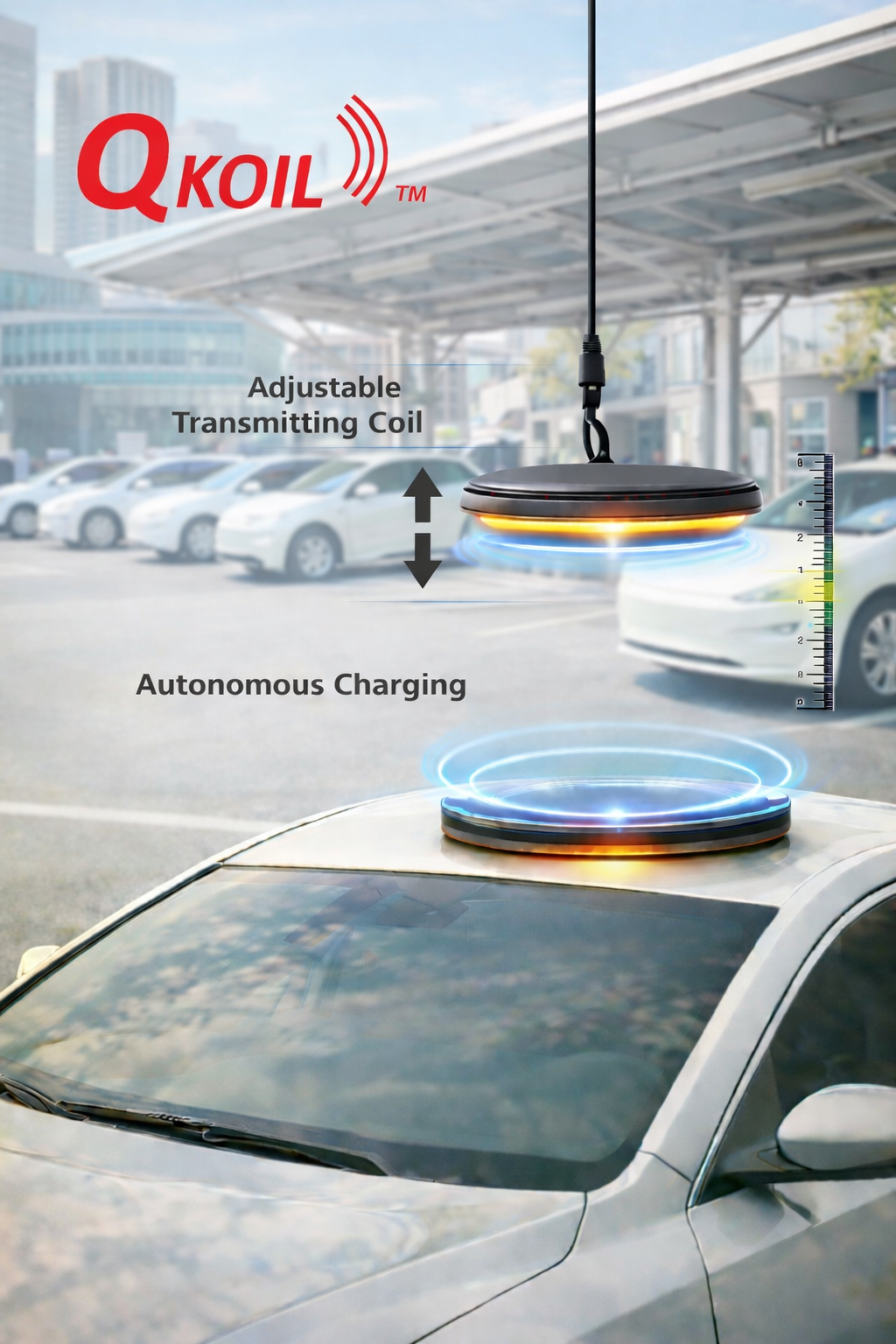
Adjustable charging gap for autonomous charging operations
Wireless charging for electric vehicles and autonomous vehicles is expected to evolve from a convenience feature into a foundational technology for autonomous mobility and high-throughput fleet operations. As development and adoption continue to progress, a critical limitation in conventional systems is becoming increasingly apparent: most wireless charging architectures are built around fixed geometries that struggle to accommodate the variability of real-world environments.
Conventional wireless EV charging solutions, typically rely on a ground-based transmitting coil embedded in a charging pad, paired with a receiving coil mounted underneath the vehicle. These systems are generally engineered around a predefined electromagnetic field and a fixed air gap between the coils. When the vehicle is properly aligned and positioned within this designed range, power transfer can be efficient and reliable. However, this efficiency is highly dependent on maintaining that ideal spatial relationship, and the gap itself is not dynamically adjustable.
In controlled environments, this approach can perform well. But in real-world fleet operations, particularly those involving autonomous vehicles, logistics platforms, or mixed fleets of different vehicle types, conditions are rarely ideal. Variations in vehicle height, suspension movement during loading and unloading, uneven ground surfaces, and minor inconsistencies in parking position can all affect the distance and alignment between the transmitting and receiving coils. Even small deviations can quietly degrade performance, reducing power transfer efficiency, increasing charging times, and generating excess heat in both the charging hardware and the vehicle’s battery management system. These inefficiencies often go unnoticed in individual sessions but can compound significantly across large-scale operations.
This is where QKOIL™ introduces a fundamentally different approach. Rather than treating the charging gap as a fixed constraint, QKOIL™ incorporates it into an intelligent, adaptive control system. At the core of this innovation is a closed-loop architecture that continuously monitors key charging parameters during an active session, including power transfer efficiency, the coupling coefficient between coils, voltage and current levels, and real-time power loss. Using this data, the system dynamically adjusts the position of the transmitting coil along the vertical, or Z-axis, iteratively refining the gap distance until optimal coupling is achieved.
Importantly, this is not a one-time calibration. The system continues to adapt throughout the charging session, responding in real time to changes such as vehicle settling, load shifts, or environmental factors that would otherwise degrade performance. By maintaining optimal alignment and spacing between the coils, QKOIL™ ensures that energy transfer remains efficient and stable under actual operating conditions, rather than only under ideal assumptions.
The implications of this capability are substantial. By continuously optimizing the charging gap, QKOIL™ reduces energy losses and improves overall system efficiency, which directly translates into lower operating costs for fleet operators. Charging sessions can be completed more quickly because the system maintains optimal coupling, increasing vehicle uptime and throughput. At the same time, improved efficiency reduces thermal stress on both the charging infrastructure and the vehicle’s battery systems, supporting longer component lifespans and greater reliability over time.
Equally important is the role this technology plays in enabling true autonomous charging. Autonomous vehicles cannot rely on perfect positioning or human intervention to achieve optimal alignment. QKOIL™ addresses this challenge by making the charging system itself adaptive, capable of compensating for imperfect positioning and dynamically correcting for misalignment during operation. This allows autonomous vehicles to charge reliably without requiring precision parking, which is essential for scalable deployment.
The benefits become even more pronounced in mixed-fleet environments, such as logistics hubs or warehouse facilities, where vehicles of different sizes, heights, and configurations share the same charging infrastructure. Traditional fixed-gap systems often require multiple charging pads or vehicle-specific configurations to accommodate these differences, consuming valuable space and increasing complexity. In contrast, a single QKOIL™ charging station can adapt to a wide range of vehicles in real time, eliminating the need for redundant infrastructure and making more efficient use of physical space.
Ultimately, QKOIL™ represents a shift from static hardware to intelligent charging infrastructure. By combining real-time sensing, feedback-driven control, and dynamic mechanical adjustment, it transforms wireless charging into a responsive, self-optimizing system capable of meeting the demands of modern mobility. As fleets become more diverse and autonomous systems more prevalent, the ability to dynamically adjust the charging gap will not just be an advantage; it will be a necessity.