

The Autonomy Paradox:Why True Autonomous Charging Is the Missing Piece in the Robotaxi Revolution
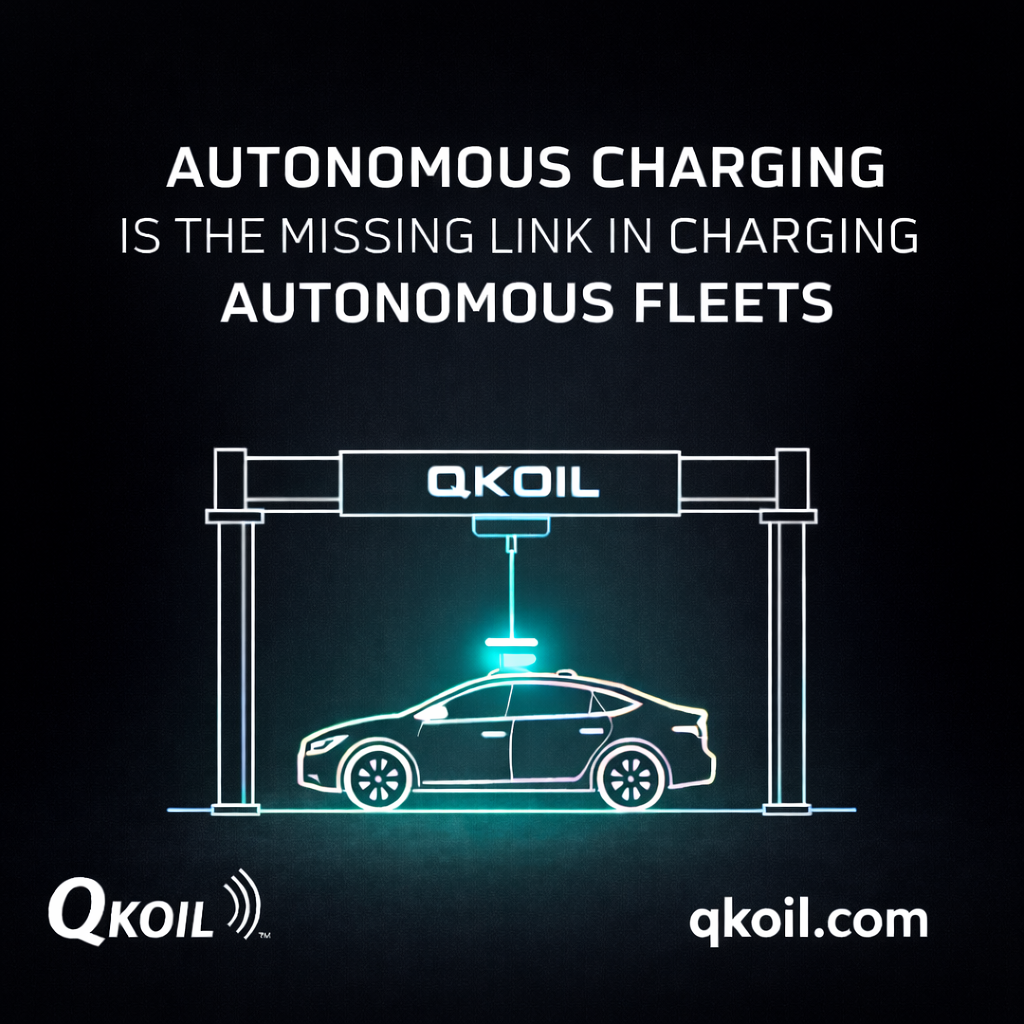
Autonomous Charging
The autonomous vehicle revolution has arrived. Or has it? Robotaxis now navigate the streets of major cities across the United States. Sensors, cameras, and AI systems guide vehicles through intersections, merge onto highways, and pick up passengers without a human hand touching the wheel. The promise of fully autonomous mobility appears tantalizingly close.
But there is a quiet contradiction lurking at the heart of every robotaxi fleet in operation today: when these supposedly driverless vehicles return to their depots at the end of a shift, a human being walks out and plugs them in. The vehicle that drove itself across a city cannot charge itself. The "autonomous" taxi relies on human attendants to keep it alive.
This gap, between the sophisticated self-driving system and the manual charging infrastructure that sustains it, is more than a minor inconvenience. It is a fundamental bottleneck that limits scalability, drives up operational costs, and exposes a philosophical contradiction in how we define autonomy. Emerging technologies like the QKOIL overhead wireless charging system represent a new approach: true end-to-end autonomy where the vehicle not only drives itself, but charges itself too.
The Hidden Human Labor Behind "Driverless" Fleets
Investigative reporting and regulatory filings have revealed a reality that fleet operators rarely highlight in their marketing materials: charging depots are staffed around the clock with human attendants whose primary job is to plug vehicles in, perform interior cleaning, and manage the flow of cars through the lot. Neighbors near these depots have reported being kept awake at night by beeping backup alerts and the general activity of what amounts to a continuous industrial operation, the hubbub generated by the robots' human attendants plugging them in to charge and servicing them between rides. The beeping, the lights, the constant vehicle movement, these have become flashpoints in multiple communities where robotaxi operators have sought to expand.
The irony is not lost on critics. These vehicles have been sold to regulators and the public on the promise of replacing human labor with machine intelligence. Yet behind every driverless taxi is a small army of support workers keeping the system running. This dependency on manual charging is not a temporary workaround; it is baked into the current generation of robotaxi infrastructure.
Remote Operators: The Other Hidden Workforce
Manual charging is not the only human dependency in today's AV fleets. Industry disclosures to regulators have confirmed that leading robotaxi companies employ remote operators (sometimes located overseas) to provide guidance to their vehicles in challenging situations. While operators maintain that these workers do not remotely drive the vehicles and that the autonomous system remains in control of all dynamic driving tasks, the admissions reveal the degree to which "autonomous" vehicles still lean on human judgment to function safely.
Internal data shared during regulatory proceedings showed that some robotaxi systems triggered a remote human assistance session as frequently as every four to five miles — meaning human oversight was required at a rate that would be completely impractical at true commercial scale. Each of these sessions represented a human worker monitoring a screen, making a judgment call, and feeding information back into a system that is supposed to operate independently.
The emerging picture is one of what researchers have come to call the autonomy illusion: a system that presents as autonomous to passengers and the public but that remains deeply dependent on human labor at multiple layers, from charging and cleaning to remote guidance and intervention. For the robotaxi industry to achieve its full potential, each of these layers must eventually be automated. Charging is among the most immediate and tractable.
The Problems with Manual AV Charging
The dependency on human operators for charging creates a cascade of operational, financial, and safety problems that become more acute as fleets scale. Understanding these problems is essential to appreciating why autonomous charging solutions are not a luxury but a necessity.
1. Operational Scaling Walls
Fleet operators face a fundamental math problem: as their fleet of vehicles grows, the number of human charging attendants required to service those vehicles must grow proportionally. A depot with 100 vehicles requires a staffed shift to ensure every vehicle is plugged in, monitored for charge level, and unplugged and redistributed at the right time. A depot with 1,000 vehicles requires a staffing operation that begins to look more like a traditional transportation company than a technology startup.
This scaling problem directly undercuts the economics of the robotaxi model. The central promise of autonomous vehicles is that they replace expensive human labor, particularly the driver, with a one-time capital investment in technology. If that saving is partially offset by a permanent need for charging attendants, the economic case for robotaxis weakens considerably. True autonomy demands that the vehicle manage its own energy replenishment without human assistance.
2. Downtime and Utilization Losses
Manual charging operations introduce coordination delays that idle vehicles unnecessarily. A vehicle returning to a depot must wait for an available attendant to connect the charger, during which time it generates zero revenue and occupies space. In high-demand periods, when many vehicles return simultaneously, queuing for human attention can significantly extend downtime. Every minute a vehicle spends waiting to be plugged in rather than actively charging, or actively serving passengers, represents a direct revenue loss.
By contrast, an autonomous charging system can initiate charging the moment a vehicle parks, without delay, without coordination, and without the variability introduced by human scheduling. The efficiency gains at fleet scale are substantial.
3. Overnight and Off-Peak Community Impact
Depot operations staffed with human workers create community disturbances that have real regulatory and reputational consequences. The backup beeping of vehicles maneuvering in the dark, the noise of vacuums and cleaning equipment, the activity of workers arriving and departing on shift schedules; all of these generate complaints from neighboring residents and have prompted local governments in multiple cities to push back against robotaxi depot expansions.
An autonomous charging operation, by contrast, can run quietly and efficiently without the human activity that generates noise and disruption. Vehicles park, the charging system engages automatically, and the depot falls largely silent. The reduction in community friction could prove as valuable as the direct operational savings.
4. Cost of Human Labor
Charging attendants represent a significant and ongoing labor cost. At current fleet sizes, this cost may appear modest. But as robotaxi companies project fleet expansions into the tens of thousands of vehicles, the cumulative cost of staffing charging depots 24 hours a day, seven days a week, across multiple cities, becomes material. Every automated function that replaces a manual one improves the unit economics of the business, making the service more affordable for passengers and more profitable for operators.
5. Human Error and Inconsistency
Manual charging operations introduce the variability inherent in any human process. An attendant may connect a charger improperly, fail to notice a vehicle with critically low charge, prioritize the wrong vehicles for charging during a busy period, or simply be unavailable when needed. Automated systems, properly designed, can optimize charging schedules based on real-time demand data, battery state, and fleet positioning, consistently, without fatigue, and at any hour of the day or night.
What True Autonomous Charging Looks Like: The QKOIL System
Against this backdrop of manual charging limitations, a new generation of autonomous charging technologies is emerging. Among the most innovative is the QKOIL overhead wireless charging system, developed by EV Charging Solutions, LLC, a company founded in 2022 and based in Albuquerque, New Mexico.
An Overhead Approach to a Ground-Level Problem
Most wireless EV charging systems take a ground-based approach: a charging pad is embedded in the floor, and the vehicle parks over it, with a receiver coil on the vehicle's underside picking up the transmitted power. This design, while conceptually simple, comes with significant practical drawbacks — the pad is exposed to road debris and moisture, precise alignment is required, and a single pad can only serve one vehicle at a time.
QKOIL takes a fundamentally different approach. Rather than embedding charging infrastructure in the floor, the system mounts a transmitting coil on an overhead cable or arm that can move electromechanically in three axes — X, Y, and Z. When a vehicle parks beneath the system, sensors identify the vehicle's position and guide the transmitting coil to align with a receiving coil mounted on or within the hood or roof of the vehicle. Charging begins automatically, without any manual intervention, and without requiring the vehicle to park with precise alignment.
This overhead design eliminates several of the most persistent problems with ground-based wireless charging. The transmitting coil is protected from debris, moisture, and physical damage. The three-axis movement compensates for parking variability, removing the need for precision alignment. And because the system is mounted overhead and can traverse a gantry spanning multiple parking spaces, a single QKOIL installation can sequentially charge multiple vehicles — dramatically reducing the infrastructure investment required per vehicle.
Multi-Vehicle Sequential Charging
One of QKOIL's most commercially significant features is its ability to serve multiple vehicles from a single overhead installation. Using a gantry design, the transmitting coil can traverse several adjacent parking spaces, completing a charge on one vehicle before moving to the next. For fleet operators managing dozens or hundreds of vehicles in a depot, this means fewer installed units, lower capital expenditure, and simpler infrastructure management.
The system's controller and sensors handle the entire process: identifying vehicle positions, determining charge priority based on battery state, guiding the transmitting coil to the correct position, initiating the charge, monitoring progress, and moving to the next vehicle when charging is complete. No human direction is required at any stage.
Beyond Cars: Autonomous Vehicles of All Kinds
The implications of QKOIL's technology extend well beyond passenger robotaxis. The same charging challenges that afflict robotaxi fleets are present throughout the autonomous logistics and manufacturing sectors. Autonomous mobile robots (AMRs) in fulfillment centers, automated guided vehicles (AGVs) on factory floors, autonomous floor-cleaning robots in airports and shopping centers, and even delivery drones all face the same fundamental problem: they need to recharge, and most current solutions require a human to make that happen.
QKOIL's overhead system is designed to serve this broader ecosystem of autonomous electric machines. In a warehouse environment, for example, the system can charge a fleet of inventory robots during off-peak hours without any human coordination. The robots park in designated spaces, the overhead system identifies them and initiates charging, and they return to service with full batteries. The vision is one of truly uninterrupted autonomous workflow, where energy management becomes as invisible and automatic as any other aspect of the system's operation.
Eliminating Ground-Based Hazards
Fleet operators and property managers have an additional practical reason to prefer overhead wireless charging over both plug-in systems and ground-based wireless pads. Ground-level charging infrastructure creates trip hazards for both pedestrians and vehicles. Cables stretched across parking areas, floor-embedded pads that protrude slightly above the surface, and junction boxes mounted at vehicle height all represent potential causes of accidents and liability.
An overhead system removes this infrastructure from the pedestrian environment entirely. The charging mechanism operates above the vehicles, invisible to people walking through the space and inaccessible to casual contact. For commercial properties, hotels, apartment complexes, and public parking structures, all of which QKOIL is targeting, this safety profile is commercially significant.
The Broader Case for End-to-End Autonomy
The argument for autonomous charging is ultimately an argument about what autonomy actually means. The current generation of robotaxi technology has achieved something genuinely impressive: it has automated the driving task. But automation of the driving task alone does not create a truly autonomous vehicle. A vehicle that cannot manage its own energy is not autonomous in any meaningful sense; it is a sophisticated machine that remains dependent on human infrastructure for its most basic operational need.
True autonomy requires that the vehicle manage its entire operational lifecycle without human intervention: driving, navigation, maintenance scheduling, and energy replenishment. Wireless charging systems like QKOIL represent a significant step toward closing this gap. As the technology matures and scales, the charging depot staffed with human attendants will come to seem as anachronistic as the horse-drawn carriage, a transitional artifact from an earlier era.
The Safety Case
There is also a safety dimension to autonomous charging that deserves consideration. Human attendants operating in busy depot environments face genuine physical risks: moving vehicles, electrical systems, fatigue during overnight shifts. Automating the charging process removes workers from these hazardous environments, replacing repetitive physical labor with reliable machine operation. For the insurance actuaries and safety regulators who scrutinize AV operations, this is not a trivial consideration.
The Regulatory Case
Regulators and communities that have grown skeptical of robotaxi operations (and high-profile incidents in multiple cities have given them legitimate reasons for caution) may find true autonomous charging operations easier to accept than the current hybrid model. A depot that operates quietly and automatically, without the community disruption of human shift workers and constant vehicle movement, presents a much smaller footprint and a more plausible claim to operating in the public interest.
Conclusion: Completing the Autonomous Stack
The robotaxi industry is at an inflection point. The core technology - self-driving - has advanced to the point where commercial operations are live in multiple cities. But the supporting infrastructure, including how these vehicles recharge, has not kept pace. The result is a fleet of theoretically autonomous vehicles that still depend on human labor for one of their most fundamental needs.
Technologies like the QKOIL overhead wireless charging system offer a path to closing this gap. By enabling vehicles to charge automatically, without human intervention, without precise parking alignment, and with a single installation capable of serving multiple vehicles, these systems address the operational, economic, and philosophical shortcomings of manual charging at their root.
The autonomous vehicle revolution will only be complete when the entire stack from navigation to energy management, operates without human dependency. The charging problem is solvable. The solutions are emerging. The industry that moves first to implement them will gain a structural advantage that compounds with every vehicle added to the fleet and every city entered. In the race toward true autonomy, the charger matters as much as the drive.
Learn more at qkoil.com.